


Picture this: a procurement manager in a chemical plant gets an urgent call that a rubber joint has burst on a cooling water line. The replacement order is rushed, but the part fails again within months. The root cause? No one asked the right question at the specification stage: What is the difference between rubber and metal expansion joints? This single question determines how your piping system handles temperature swings, vibration, corrosion, pressure spikes, and movement. Rubber Expansion Joints are engineered elastomeric connectors that absorb shock, reduce noise, and compensate for misalignment in lower-pressure or moderate-temperature systems. Metal expansion joints are fabricated from stainless steel or high alloys and are built to withstand extreme heat, high pressure, and aggressive chemicals. Selecting the wrong one leads to unplanned shutdowns, safety hazards, and wasted procurement budgets. Ningbo Kaxite Sealing Materials Co., Ltd. works with international buyers every day to eliminate this guesswork by matching joint design to actual operating conditions. In this guide, we translate engineering data into a practical selection framework so you can specify the right joint the first time and avoid costly repeat failures.
Expansion joints are flexible connectors installed in piping systems to absorb movement, reduce stress, and isolate vibration. Procurement professionals often face a confusing mix of catalog numbers, material grades, and movement ratings. Without a clear baseline, it is easy to overpay for a metal joint when a rubber unit would last longer, or to buy rubber for a steam line where it will soften and fail.
A practical way to start is to define three operating factors: temperature, pressure, and media chemistry. Rubber joints typically use EPDM, nitrile, neoprene, or natural rubber bodies with fabric reinforcement and metal flanges. They handle temperatures up to about 100–120°C for EPDM and slightly higher for some specialty compounds. Metal joints use stainless steel bellows, usually 304L, 316L, or higher alloys, and can operate above 500°C depending on the alloy. Pressure ratings vary widely, but metal bellows are generally preferred in systems exceeding 16 bar or in vacuum service where rubber may collapse or delaminate.
For a sourcing team, asking “What is the difference between rubber and metal expansion joints?” is not a sign of inexperience. It is the most effective first filter. The answer helps you narrow the supplier list, compare material certifications, and write a clear request for quotation. Ningbo Kaxite Sealing Materials Co., Ltd. supplies both standard and custom rubber expansion joints and supports buyers with data sheets that list movement capabilities, pressure classes, and elastomer compatibility. This early clarity prevents expensive trial-and-error purchasing.
A common painful scenario is receiving two quotes with similar dimensions but vastly different prices. The procurement team cannot tell why one joint costs three times more. The answer usually lies in design and material. To make a confident decision, compare the performance parameters side by side.
| Parameter | Rubber Expansion Joint | Metal Expansion Joint |
|---|---|---|
| Typical temperature range | -20°C to 100–120°C (compound-dependent) | -200°C to 600°C+ (alloy-dependent) |
| Pressure capability | Usually up to 16 bar; some high-strength designs up to 25 bar | Full vacuum to 40 bar or higher |
| Vibration and noise reduction | Excellent | Moderate; often requires external dampening |
| Corrosion resistance | Good with correct elastomer; limited in strong solvents or oxidizers | Excellent with 316L, Inconel, or Hastelloy |
| Movement absorption | High lateral, axial, and angular flexibility | Controlled axial and lateral movement; lower per-cycle lateral capacity |
| Fatigue life under frequent cycling | Good for low-cycle vibration | Excellent for high-cycle thermal expansion |
| Initial cost | Lower | Higher |
| Maintenance needs | Periodic inspection for liner wear and flange sealing | Inspection of bellows for fatigue cracks and pitting |
The table above is not a ranking. It is a selection map. If your system struggles with pump vibration and noise complaints, rubber is often the cost-effective answer. If your plant operates superheated steam or high vacuum, metal becomes mandatory. Ningbo Kaxite Sealing Materials Co., Ltd. helps buyers interpret these parameters against real fluid compatibility charts. That prevents the classic mistake of choosing by initial price alone and then paying for repeated replacements.
Imagine a chilled water system in a hospital or data center. Pumps start and stop around the clock, transmitting vibration through rigid pipe supports. Occupants complain about humming noise, and pipe brackets begin to crack. A rubber expansion joint installed near the pump suction and discharge acts like a flexible isolator. It absorbs the mechanical energy, reduces noise transmission, and compensates for minor misalignment between the pump and piping.
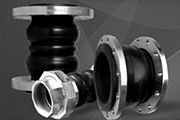
This is where rubber expansion joints outperform metal in many HVAC, water treatment, and marine cooling applications. The elastomer body can handle axial compression, extension, and lateral offset simultaneously, which rigid metal bellows cannot always do without extra tie rods or hinges. Rubber also dampens water hammer and provides electrical isolation between dissimilar pipe materials, reducing galvanic corrosion.
However, not all rubber joints are equal. Buyers should specify the correct elastomer: EPDM for hot water and mild chemicals, nitrile for oils and fuels, neoprene for refrigeration, and natural rubber for abrasion resistance. The nylon or aramid reinforcement layers determine pressure capacity. Ningbo Kaxite Sealing Materials Co., Ltd. manufactures rubber expansion joints with multiple reinforcement plies, rotating flanges, and FDA-compliant liners for potable water. Our team reviews your fluid, temperature, and movement data to recommend the right compound, flange standard, and face-to-face length. That lowers the risk of selecting a generic joint that swells in the wrong chemical or softens at elevated temperature.
Now shift to a refinery or power plant. A high-pressure steam line cycles from ambient to 400°C several times a day. Thermal expansion creates axial forces that can rip rigid anchors out of concrete. Rubber is not an option here because the temperature would degrade the elastomer and the pressure could burst the body. Metal expansion joints, typically made from 316L stainless steel or Inconel, are designed for exactly this environment. Their corrugated bellows flex with thermal growth while maintaining pressure integrity.
Metal joints also work in full vacuum lines, cryogenic service, and corrosive chemical transfers where rubber liners may not be compliant. The downside is that metal bellows are less forgiving with vibration unless the design includes external hardware such as tie rods, hinges, or gimbals. They also cost more and require precise installation alignment to avoid premature fatigue cracking.
For procurement teams, the decision often comes down to failure mode. If a failed joint would release steam, acid, or flammable fluid, the safety margin of a metal expansion joint often justifies the investment. At the same time, not every hot line needs metal. We sometimes see buyers over-specify metal for 80°C water systems, losing money and vibration control. Ningbo Kaxite Sealing Materials Co., Ltd. supports balanced sourcing by supplying rubber expansion joints for moderate conditions and helping buyers source metal joints when alloys, pressure classes, and fatigue life are non-negotiable. This integrated approach saves budget without compromising safety.
Rubber expansion joints provide significantly better vibration and noise isolation than metal expansion joints. The elastomer material absorbs mechanical energy from pumps, compressors, and fans before it transfers into the pipe structure. Metal expansion joints, especially thin-walled bellows, can transmit vibration and may even resonate if the excitation frequency matches their natural frequency. That is why rubber joints are commonly used in HVAC, water circulation, and marine cooling systems where noise control is a priority. Metal joints are preferred when temperature or pressure makes rubber unsuitable, and vibration damping can be added externally with rubber pads or spring mounts.
Chemical compatibility depends on the material, not just the joint category. Rubber expansion joints use different elastomers—EPDM, nitrile, neoprene, butyl, or natural rubber—each suitable for specific fluids. For example, EPDM works well with hot water and diluted acids but swells in petroleum oils. Nitrile handles oils and fuels but is not ideal for strong oxidizing acids. Metal expansion joints made from 316L stainless steel resist many chemicals but can suffer chloride stress corrosion cracking in seawater or chlorinated environments unless upgraded to an alloy such as 254 SMO or Inconel. A proper selection should compare both the elastomer compatibility chart and the metal alloy corrosion data against your actual process fluid. Ningbo Kaxite Sealing Materials Co., Ltd. provides this comparison for buyers to prevent material mismatch before purchase.
Even the best expansion joint fails early if installed incorrectly. A common site problem is forcing a rubber joint to compensate for severe pipe misalignment beyond its rated movement. Installers sometimes tighten flange bolts unevenly, which distorts the sealing face and creates leaks. Another frequent issue is storing rubber joints in direct sunlight or near ozone-generating equipment, which degrades the elastomer before installation.
To avoid these pitfalls, always align the piping first, then install the expansion joint in a neutral position. Use torque wrenches and tighten flange bolts in a star pattern. For rubber joints, check that the arch is not pinched or over-stretched. For metal joints, ensure that the bellows are not twisted during pipe fit-up and that anchors and guides are installed according to the piping flexibility analysis. Periodic inspection should look for surface cracks, bulging, liner wear, and flange corrosion.
Ningbo Kaxite Sealing Materials Co., Ltd. includes installation and storage guidelines with every shipment. Our technical team can review your piping layout drawings and movement calculations to help you choose the right joint length and hardware configuration. This proactive support reduces the hidden costs of downtime and rework, which often outweigh the initial purchase price.
When your project depends on reliable piping connections, you need more than a parts supplier. You need a partner who understands how the answer to “What is the difference between rubber and metal expansion joints?” translates into lower total cost of ownership. Ningbo Kaxite Sealing Materials Co., Ltd. has served global industrial buyers with quality rubber expansion joints, documented material traceability, and responsive technical support. Whether you are replacing a failed joint on a cooling tower, standardizing MRO specifications, or developing a new pump skid, we help you match the right product to the application instead of pushing the highest-margin item.
What is the biggest challenge you face with expansion joint selection? Is it vibration, chemical attack, high temperature, or simply getting clear data from suppliers? Share your operating parameters with our engineers, and we will recommend a practical solution with supporting technical data.
Ningbo Kaxite Sealing Materials Co., Ltd. is a professional manufacturer and exporter of rubber expansion joints, sealing materials, and piping accessories. We combine production experience with international standards such as ISO, ANSI, DIN, and JIS to serve buyers across water treatment, HVAC, marine, chemical, and power industries. Visit https://www.rubber-expansion-joint.com to explore our product range, or contact us directly at kaxite@seal-china.com for a technical consultation and quotation. We will help you eliminate guesswork in expansion joint selection and keep your piping systems running safely and efficiently.
Anderson, K. J. (2018). Material Selection Criteria for Expansion Joints in Industrial Piping Systems. Journal of Pressure Vessel Technology, 140(4), 041203.
Smith, R. L., & Lee, C. H. (2019). Comparative Fatigue Life of Elastomeric and Metallic Bellows Expansion Joints Under Simulated Pump Vibration. International Journal of Pressure Vessels and Piping, 172, 112–121.
Chen, Y., Zhao, M., & Patel, R. (2020). Corrosion Resistance of Stainless Steel Expansion Joints in Chemical Processing Environments. Corrosion Science, 166, 108–117.
Miller, D. A. (2017). Vibration Isolation in HVAC Piping Systems: The Role of Rubber Expansion Joints. ASHRAE Journal, 59(9), 34–41.
Wang, L., & Gupta, S. (2021). Thermal Expansion Analysis of Metal Bellows in High-Temperature Steam Lines. Journal of Thermal Stresses, 44(6), 658–672.
Davis, J. R. (2016). Rubber Liner Performance in Water and Wastewater Applications. Journal of Protective Coatings & Linings, 33(2), 18–26.
Thompson, B. J., & Evans, M. (2020). Failure Analysis of Rubber Expansion Joints in Marine Cooling Systems. Engineering Failure Analysis, 112, 104–115.
Liu, X., Kim, S., & Hernandez, A. (2019). Effect of Reinforcement Ply Design on Pressure Capacity of Fabric-Reinforced Rubber Expansion Joints. Rubber Chemistry and Technology, 92(3), 497–510.
Nakamura, H., & Oka, T. (2018). Fatigue Life Prediction of Metal Bellows Under Combined Axial and Lateral Loading. International Journal of Fatigue, 116, 231–241.
Garcia, P., & Singh, R. (2022). Comparative Lifecycle Cost Assessment of Rubber and Metal Expansion Joints in District Heating Networks. Energy Procedia, 215, 240–249.


