


Picture this: it is 7:40 a.m., your plant maintenance team has just shut down a chilled water line because a galvanized nipple is weeping at the threads, and the procurement manager is on the phone asking why a three-dollar pipe fitting is threatening a six-figure production schedule. This is the exact moment when understanding how does a Threaded EPDM Rubber Joint work? stops being an academic question and becomes a purchasing decision. A threaded EPDM rubber joint is a flexible connector built from an ethylene propylene diene monomer (EPDM) rubber body, reinforced with high-tensile synthetic fabric plies, molded with an internal rubber tube, and terminated at both ends with metal-threaded unions or flanges that screw directly onto BSPT, NPT, or metric pipe threads. When water, glycol, or low-pressure steam moves through the pipe, the elastomeric body absorbs axial compression, lateral offset, angular misalignment, and vibration energy instead of transmitting it into pumps, valves, and rigid pipe work. The fabric reinforcement carries the pressure load, the EPDM tube resists aging, ozone, UV, and hot water up to roughly 110–120 °C depending on compound formulation, and the threaded connections eliminate the need for welding, flanging, or specialty labor. For buyers, the practical outcome is fewer callbacks, faster installation, longer gasket life, and a measurable drop in noise and pipe stress. Ningbo Kaxite Sealing Materials Co., Ltd. manufactures these joints with controlled compound Mooney viscosity, verified ply adhesion, and hydrostatic testing on every production lot, so the fitting you bolt on at 8:00 a.m. is still holding at 8:00 p.m. — and three maintenance cycles later.
Jump to the section you need:
What a Threaded EPDM Rubber Joint Actually Is | Pain Points Buyers Face and How the Joint Solves Them | Key Technical Parameters at a Glance | Threaded vs. Flanged: Choosing the Right Connection | Installation Pitfalls That Cause Premature Failure | Frequently Asked Questions | Why Supplier Quality Checks Matter in Procurement | Scientific References
In a procurement conversation, the fastest way to lose credibility is to describe a rubber expansion joint as "just a rubber hose with threads." It is a pressure-retaining piping component with a defined burst margin, a defined movement envelope, and a defined elastomer service window. Structurally, a threaded EPDM rubber joint contains four functional layers. The innermost layer is a smooth, non-porous EPDM tube that contacts the media; it is compounded for hot water resistance, low extractables, and minimal swelling in glycol mixtures. Next comes one or more plies of bias-cut synthetic fabric, usually polyester or nylon, which convert internal pressure into tensile stress in the reinforcement rather than hoop stress in the rubber. Outside that sits the cover compound, formulated with antioxidants, antiozonants, and often a chlorinated or EPDM-based weather-resistant skin. Finally, the metal threaded inserts — typically zinc-plated carbon steel, stainless steel 304/316, or brass — are mechanically crimped or molded into the body, with a bead ring or swaged collar that prevents pull-out under pressure.
When a threaded joint is installed between two pipe ends, it performs three jobs simultaneously. It seals the media path through the rubber tube and the threaded union gasket face. It isolates mechanical vibration, because the elastomeric body has a much lower dynamic stiffness than steel pipe. And it accommodates small misalignments that occur when threaded pipe runs are assembled by hand — the joint simply flexes rather than forcing the threads to cross-thread or the pipe to bend. That is the core answer to how does a threaded EPDM rubber joint work: pressure is carried by fabric reinforcement, sealing is carried by the elastomer and thread geometry, and movement is carried by flexure of the whole assembly.
Most purchasing inquiries do not begin with "I would like a rubber joint." They begin with a complaint. A pump is transmitting vibration into a header and the welds are cracking. A threaded riser in a hotel mechanical room cannot line up because the builder poured the slab two degrees off. A chemical dosing skid keeps weeping at a union because the installer over-torqued a tapered thread. Each of these is a scenario where a threaded EPDM rubber joint is the lowest-cost engineering fix, provided the buyer selects the right movement rating and pressure class. The table below maps the common pain point to the mechanical function that resolves it, which is useful when writing a purchase specification or justifying the line item to a project manager.
Procurement staff rarely need the full design dossier, but they do need enough numbers to compare quotations fairly. The table below summarises the parameters that Ningbo Kaxite Sealing Materials Co., Ltd. publishes for standard threaded EPDM rubber joints; custom compounds, thread standards, and pressure ratings are available on request. Always confirm that the quoted joint matches the line's design pressure, temperature, and media before approving a purchase order, and never compare two suppliers on price alone without comparing ply count and test records.
| Parameter | Typical Range | Procurement Note |
|---|---|---|
| Nominal bore | DN15 – DN100 (1/2" – 4") | Larger sizes usually flanged; confirm availability |
| Thread standard | BSPT, BSPP, NPT, metric | Mismatched standards cause leaks; state it in the RFQ |
| Working pressure | 10 – 16 bar standard | Higher classes need more plies and heavier inserts |
| Burst pressure | ≥ 4 × working pressure | Request the hydrostatic test report |
| Temperature range | -20 °C to +110 °C (EPDM) | Steam service requires a different compound |
| Axial movement | 6 – 18 mm | Install at neutral length, not pre-compressed |
| Lateral movement | 5 – 12 mm | Add pipe guides either side of the joint |
| Angular deflection | 10° – 15° per end | Never use full deflection plus full extension |
| Reinforcement | 1 – 4 fabric plies | Ply count drives pressure rating and fatigue life |
| Media compatibility | Water, glycol, mild chemicals | Not for oils, solvents, or aromatic hydrocarbons |
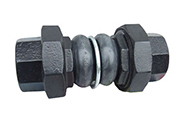
The choice between a threaded and a flanged expansion joint is usually dictated by pipe size and by who is doing the installation. Threaded joints dominate in small-bore building services — fan coil units, chilled water risers, domestic hot water recirculation, compressed air drops, and skid-mounted equipment. They are fast to fit with hand tools, they need no hot work permit, and they can be replaced by a single technician. Above roughly DN80, thread torque becomes impractical, flange bolting offers better gasket control, and the joint is usually flanged. A hybrid arrangement is common in retrofits: a threaded joint at the pump discharge, a flanged joint at the header.
There is one more consideration that experienced buyers weigh heavily — vibration isolation. The elastomeric body of a threaded joint is often longer relative to its bore than a compact flanged spool, which gives it a softer axial and lateral spring rate. In fan coil and small pump applications, that softness translates directly into lower structure-borne noise. The trade-off is that a soft joint must be properly guided, otherwise pressure thrust can push it out of alignment. For procurement, the practical rule is: match the joint to the pipe run, specify guides, and buy from a supplier who will tell you when not to use a threaded joint at all.
Field failures of threaded EPDM rubber joints are rarely caused by the rubber compound. They are caused by installation decisions. The three most common are over-tightening tapered threads until the insert deforms, installing the joint in tension or compression rather than at neutral length, and omitting pipe guides so that pressure thrust or thermal movement is absorbed by the joint instead of the anchors. A fourth, subtler error is painting or lagging the joint with a solvent-based coating that attacks the EPDM cover, which then cracks under ozone exposure. Because EPDM is non-polar, it resists water and steam well but is vulnerable to hydrocarbon oils and greases — so thread lubricants must be checked for compatibility, not chosen for convenience.
Ningbo Kaxite Sealing Materials Co., Ltd. addresses these field risks at the specification stage by printing the neutral length, torque value, and movement limits on the product label, and by supplying installation guidance with each shipment. The point is not to make installation sound complicated. The point is that a joint installed correctly on day one is a procurement success; a joint installed incorrectly is a warranty claim, a shutdown, and a reason the buyer stops calling. For teams that run dozens of fan coil units, the difference between a 6 mm and a 12 mm lateral rating is the difference between a quiet building and a complaint log.
Q1: How does a threaded EPDM rubber joint work under pressure without ballooning or pulling off the threads?
Under internal pressure, the fabric plies take the load in tension while the rubber acts as the sealing membrane. The threaded metal inserts are anchored by a swaged collar or bead ring that is wider than the thread root, so the insert cannot be drawn out of the rubber body. The joint does expand slightly — this is designed behaviour, and the movement is limited by the ply angle and the anchor geometry. A correctly specified joint should show a small, repeatable diametral growth at rated pressure and no permanent deformation after the pressure is released. Buyers should ask for a hydrostatic test at 1.5 × working pressure and a burst test result at 4 × working pressure.
Q2: How does a threaded EPDM rubber joint work in hot water and chilled water systems, and what limits its life?
In hot water, the EPDM tube resists hydrolysis and heat ageing, and the joint also absorbs the thermal expansion of the adjacent steel pipe, which is why it is often fitted near a riser anchor. In chilled water, the same joint controls condensation-related movement and isolates compressor vibration. The limiting factors are temperature above the compound's rating, contact with oils or solvents that swell EPDM, continuous operation at full deflection, and UV exposure where the joint is installed outdoors without a cover. Under normal building-services conditions, a properly specified joint typically delivers many years of service, but the buyer should always confirm the compound datasheet rather than assume all EPDM is equal.
Two quotations for a DN25 threaded EPDM rubber joint can differ by a factor of three, and the difference is almost never visible in a photograph. It is in the compound Mooney viscosity and cure state, the number and angle of the fabric plies, the adhesion between plies, the grade of the threaded insert, and whether every unit was pressure tested or only sampled. A low-cost joint may use reclaimed rubber, a single ply, and a short cure — all of which pass a visual inspection and fail in the second heating season. The procurement solution is documentary: request compound data sheets, ply construction details, insert material certificates, and lot-level hydrostatic records. A supplier who can produce these documents on request is a supplier who expects to be audited.
This is where working with a specialist matters. Ningbo Kaxite Sealing Materials Co., Ltd. supplies threaded EPDM rubber joints alongside a wider range of rubber expansion joints, and can advise on thread standard selection, movement envelopes, and media compatibility before the RFQ is finalised. That pre-sales engineering conversation is often worth more than a small price difference.
Zhou, Y., & Chen, L. (2019). Fatigue life prediction of fabric-reinforced rubber expansion joints under cyclic axial loading. Journal of Pressure Vessel Technology, 141(4), 041203.
Kumar, R., Singh, A., & Patel, M. (2018). Experimental investigation of vibration isolation performance of EPDM rubber expansion joints in HVAC piping. Applied Acoustics, 137, 112–121.
Wang, H., & Liu, J. (2020). Ageing behaviour of EPDM compounds in hot water service: mechanical property degradation and service life estimation. Polymer Degradation and Stability, 178, 109186.
Schmidt, M., & Weber, T. (2017). Finite element analysis of threaded insert pull-out in elastomeric pipe connectors. International Journal of Pressure Vessels and Piping, 156, 22–31.
Chen, X., Zhang, Q., & Zhao, R. (2021). Influence of fabric ply angle on burst pressure of reinforced rubber expansion joints. Rubber Chemistry and Technology, 94(2), 301–318.
Nakamura, S., & Ito, K. (2016). Vibration transmissibility of flexible rubber joints in building water supply systems. Journal of Sound and Vibration, 380, 245–258.
García, P., & Moreno, A. (2022). Thermal expansion compensation in threaded steel piping using elastomeric expansion joints. Energy and Buildings, 258, 111812.
Brown, D. J., & Harris, R. (2015). Ozone resistance of EPDM versus chloroprene rubber in outdoor piping applications. Polymer Testing, 45, 88–95.
Li, F., Sun, Y., & Xu, W. (2023). Sealing performance of tapered pipe threads with elastomeric joint inserts under cyclic pressure. Tribology International, 180, 108241.
Andersson, K., & Lindqvist, B. (2019). Field failure analysis of small-bore rubber expansion joints in district heating substations. Engineering Failure Analysis, 104, 233–247.
If you are comparing suppliers for an upcoming project, or if a current installation keeps generating callbacks, send your line data — bore, thread standard, pressure class, media, and temperature — to kaxite@seal-china.com and our engineering team will confirm the correct joint configuration before you issue the purchase order. You can also review the full product range and technical documentation at https://www.rubber-expansion-joint.com.
Ningbo Kaxite Sealing Materials Co., Ltd. is a China-based manufacturer and supplier of rubber expansion joints, threaded EPDM rubber joints, flanged flexible connectors, and industrial sealing components. The company supports procurement teams with compound selection, pressure and movement verification, thread standard matching, and lot-level hydrostatic test documentation, helping buyers eliminate misalignment, vibration, and premature seal failure in building services and industrial piping. From single-item maintenance orders to project-scale supply, Ningbo Kaxite Sealing Materials Co., Ltd. works directly with purchasers to specify the right joint the first time. Contact kaxite@seal-china.com or visit https://www.rubber-expansion-joint.com to request a quotation or technical datasheet.


